The International Court of Justice (ICJ) is the principal judicial
organ of the United Nations (UN). It was established in June 1945 by the
Charter of the United Nations and began work in April 1946. The seat of the Court is at the Peace Palace in The Hague
(Netherlands). Of the six principal organs of the United Nations, it is
the only one not located in New York (United States of America). The Court’s role is to settle, in accordance with international law,
legal disputes submitted to it by States and to give advisory opinions
on legal questions referred to it by authorized United Nations organs
and specialized agencies. The Court is composed of 15 judges, who are elected for terms of
office of nine years by the United Nations General Assembly and the
Security Council. It is assisted by a Registry, its administrative
organ. Its official languages are English and French.
The first known malware extortion attack, the "AIDS Trojan"
written by Joseph Popp in 1989, had a design failure so severe it was
not necessary to pay the extortionist at all. Its payload hid the files
on the hard drive and encrypted only their names,
and displayed a message claiming that the user's license to use a
certain piece of software had expired. The user was asked to pay US$189
to "PC Cyborg Corporation" in order to obtain a repair tool even though
the decryption key could be extracted from the code of the Trojan. The
Trojan was also known as "PC Cyborg". Popp was declared mentally unfit to stand trial for his actions, but he promised to donate the profits from the malware to fund AIDS research.[27]
The notion of using public key cryptography for ransom attacks was introduced in 1996 by Adam L. Young and Moti Yung. Young and Yung critiqued the failed AIDS Information Trojan that relied on symmetric cryptography
alone, the fatal flaw being that the decryption key could be extracted
from the Trojan, and implemented an experimental proof-of-concept
cryptovirus on a Macintosh SE/30 that used RSA and the Tiny Encryption Algorithm (TEA) to hybrid encrypt the victim's data. Since public key crypto is used, the cryptovirus only contains the encryption key. The attacker keeps the corresponding private
decryption key private. Young and Yung's original experimental
cryptovirus had the victim send the asymmetric ciphertext to the
attacker who deciphers it and returns the symmetric decryption key it
contains to the victim for a fee. Long before electronic money
existed Young and Yung proposed that electronic money could be extorted
through encryption as well, stating that "the virus writer can
effectively hold all of the money ransom until half of it is given to
him. Even if the e-money was previously encrypted by the user, it is of
no use to the user if it gets encrypted by a cryptovirus".[12] They referred to these attacks as being "cryptoviral extortion", an overt attack that is part of a larger class of attacks in a field called cryptovirology, which encompasses both overt and covert attacks.[12]
Examples of extortionate ransomware became prominent in May 2005.[28] By mid-2006, Trojans such as Gpcode, TROJ.RANSOM.A, Archiveus,
Krotten, Cryzip, and MayArchive began utilizing more sophisticated RSA
encryption schemes, with ever-increasing key-sizes. Gpcode.AG, which was
detected in June 2006, was encrypted with a 660-bit RSA public key.[29]
In June 2008, a variant known as Gpcode.AK was detected. Using a
1024-bit RSA key, it was believed large enough to be computationally
infeasible to break without a concerted distributed effort.[30][31][32][33]
Encrypting ransomware returned to prominence in late 2013 with the propagation of CryptoLocker—using the Bitcoindigital currency platform to collect ransom money. In December 2013, ZDNet
estimated based on Bitcoin transaction information that between 15
October and 18 December, the operators of CryptoLocker had procured
about US$27 million from infected users.[34] The CryptoLocker technique was widely copied
in the months following, including CryptoLocker 2.0 (though not to be
related to CryptoLocker), CryptoDefense (which initially contained a
major design flaw that stored the private key on the infected system in a
user-retrievable location, due to its use of Windows' built-in encryption APIs),[24][35][36][37] and the August 2014 discovery of a Trojan specifically targeting network-attached storage devices produced by Synology.[38]
In January 2015, it was reported that ransomware-styled attacks have
occurred against individual websites via hacking, and through ransomware
designed to target Linux-based web servers.[39][40][41]
Some ransomware strains have used proxies tied to Torhidden services to connect to their command and control servers, increasing the difficulty of tracing the exact location of the criminals.[42][43] Furthermore, dark web vendors have increasingly started to offer the technology as a service.[43][44][45]
Symantec has classified ransomware to be the most dangerous cyber threat.[46]
Non-encrypting ransomware
In August 2010, Russian authorities arrested nine individuals
connected to a ransomware Trojan known as WinLock. Unlike the previous
Gpcode Trojan, WinLock did not use encryption. Instead, WinLock
trivially restricted access to the system by displaying pornographic
images, and asked users to send a premium-rate SMS
(costing around US$10) to receive a code that could be used to unlock
their machines. The scam hit numerous users across Russia and
neighboring countries—reportedly earning the group over US$16 million.[15][47]
In 2011, a ransomware Trojan surfaced that imitated the Windows Product Activation
notice, and informed users that a system's Windows installation had to
be re-activated due to "[being a] victim of fraud". An online activation
option was offered (like the actual Windows activation process), but
was unavailable, requiring the user to call one of six international numbers
to input a 6-digit code. While the malware claimed that this call would
be free, it was routed through a rogue operator in a country with high
international phone rates, who placed the call on hold, causing the user
to incur large internationallong distance charges.[13]
In February 2013, a ransomware Trojan based on the Stamp.EK exploit kit surfaced; the malware was distributed via sites hosted on the project hosting services SourceForge and GitHub that claimed to offer "fake nude pics" of celebrities.[48] In July 2013, an OS X-specific
ransomware Trojan surfaced, which displays a web page that accuses the
user of downloading pornography. Unlike its Windows-based counterparts,
it does not block the entire computer, but simply exploits the behavior of the web browser itself to frustrate attempts to close the page through normal means.[49]
In July 2013, a 21-year-old man from Virginia, whose computer
coincidentally did contain pornographic photographs of underaged girls
with whom he had conducted sexualized communications, turned himself in
to police after receiving and being deceived by ransomware purporting to
be an FBI message accusing him of possessing child pornography. An
investigation discovered the incriminating files, and the man was
charged with child sexual abuse and possession of child pornography.[50]
Leakware (also called Doxware)
The converse of ransomware is a cryptovirology attack that threatens to publish stolen information from the victim's computer system rather than deny the victim access to it.[51]
In a leakware attack, malware exfiltrates sensitive host data either to
the attacker or alternatively, to remote instances of the malware, and
the attacker threatens to publish the victim's data unless a ransom is
paid. The attack was presented at West Point
in 2003 and was summarized in the book Malicious Cryptography as
follows, "The attack differs from the extortion attack in the following
way. In the extortion attack, the victim is denied access to its own
valuable information and has to pay to get it back, where in the attack
that is presented here the victim retains access to the information but
its disclosure is at the discretion of the computer virus".[52]
The attack is rooted in game theory and was originally dubbed "non-zero
sum games and survivable malware". The attack can yield monetary gain
in cases where the malware acquires access to information that may
damage the victim user or organization, e.g., reputational damage that
could result from publishing proof that the attack itself was a success.
Mobile ransomware
With the increased popularity of ransomware on PC platforms, ransomware targeting mobile operating systems
have also proliferated. Typically, mobile ransomware payloads are
blockers, as there is little incentive to encrypt data since it can be
easily restored via online synchronization.[53] Mobile ransomware typically targets the Android platform, as it allows applications to be installed from third-party sources.[53][54] The payload is typically distributed as an APK file installed by an unsuspecting user; it may attempt to display a blocking message over top of all other applications,[54] while another used a form of clickjacking to cause the user to give it "device administrator" privileges to achieve deeper access to the system.[55]
Different tactics have been used on iOS devices, such as exploiting iCloud accounts and using the Find My iPhone system to lock access to the device.[56] On iOS 10.3, Apple patched a bug in the handling of JavaScript pop-up windows in Safari that had been exploited by ransomware websites
A transformer is an electrical device that transfers electrical energy between two or more circuits through electromagnetic induction.
Ideal transformer equations (eq.)
By Faraday's law of induction: . . . (1)[a] . . . (2)
Combining ratio of (1) & (2)
Turns ratio . . . (3) where
for step-down transformers, a > 1
for step-up transformers, a < 1
By law of conservation of energy, apparent, real and reactive power are each conserved in the input and output . . . (4)
Combining (3) & (4) with this endnote[b][4] yields the ideal transformer identity . (5)
By Ohm's law and ideal transformer identity . . . (6)
Apparent load impedance Z'L (ZL referred to the primary) . (7)
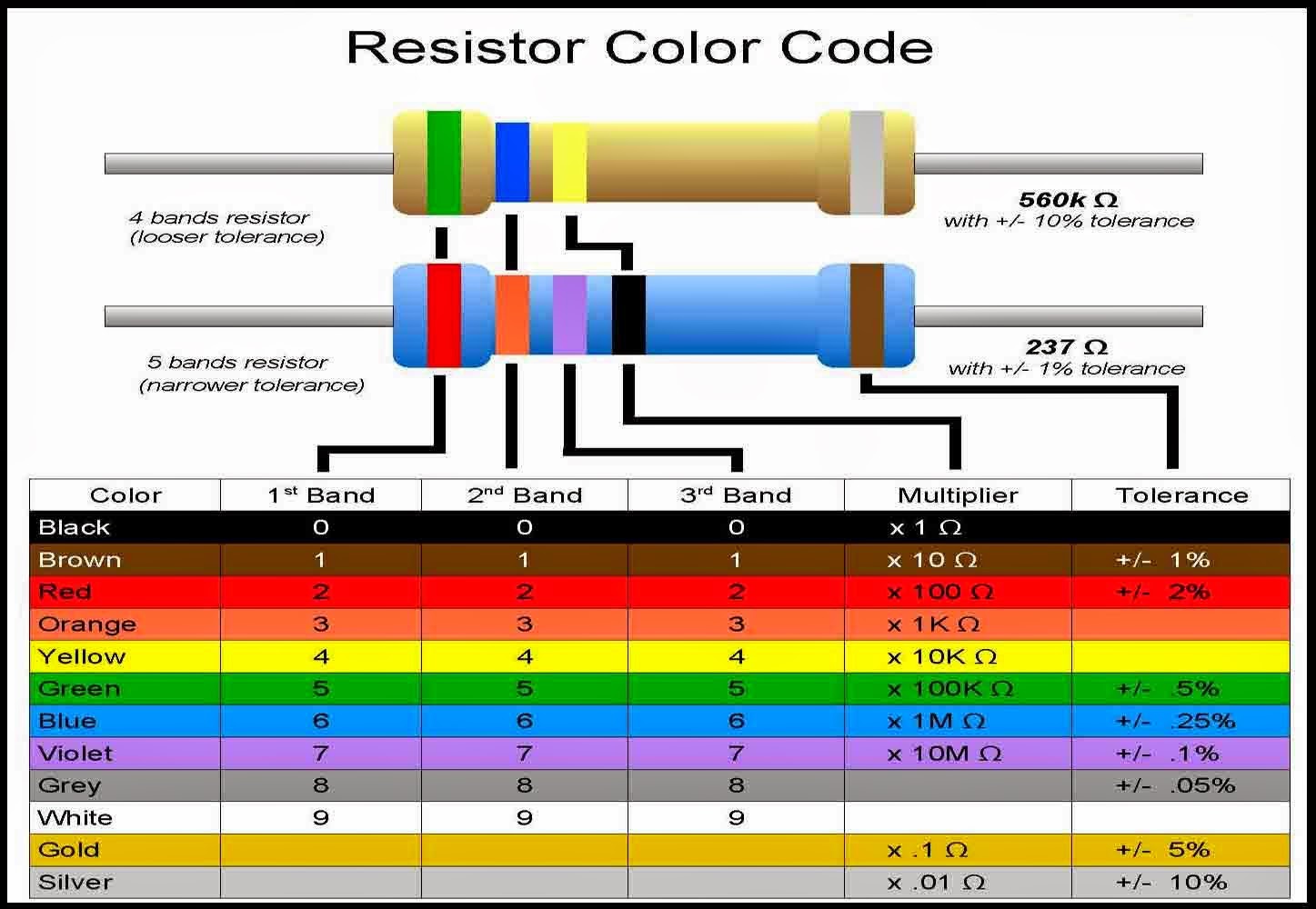
The electronic color code is used to indicate the values or ratings of electronic components, usually for resistors, but also for capacitors, inductors, diodes and others.
Calculating Resistor Values
The Resistor Colour Code system is all well and good
but we need to understand how to apply it in order to get the correct
value of the resistor. The “left-hand” or the most significant coloured
band is the band which is nearest to a connecting lead with the colour
coded bands being read from left-to-right as follows;
Digit, Digit, Multiplier = Colour, Colour x 10 colour in Ohm’s (Ω’s)
For example, a resistor has the following coloured markings;
YellowVioletRed = 472 = 47 x 102 = 4700Ω or 4k7.
The fourth and fifth bands are used to determine the percentage
tolerance of the resistor. Resistor tolerance is a measure of the
resistors variation from the specified resistive value and is a
consequence of the manufacturing process and is expressed as a
percentage of its “nominal” or preferred value.
Related Products: Resistor Fixed Single-Other Mounting
Typical resistor tolerances for film resistors range from 1% to 10%
while carbon resistors have tolerances up to 20%. Resistors with
tolerances lower than 2% are called precision resistors with the or
lower tolerance resistors being more expensive.
Most five band resistors are precision resistors with tolerances of
either 1% or 2% while most of the four band resistors have tolerances of
5%, 10% and 20%. The colour code used to denote the tolerance rating of
a resistor is given as;
Brown = 1%, Red = 2%, Gold = 5%, Silver = 10 %
If resistor has no fourth tolerance band then the default tolerance would be at 20%.
It is sometimes easier to remember the resistor colour code by using
mnemonics or phrases that have a separate word in the phrase to
represent each of the Ten + Two colours in the code. However, these
sayings are often very crude but never the less effective for
remembering the resistor colours. Here are just a few of the more
“cleaner” versions but many more exist:
Bad Booze Rots Our Young Guts But Vodka Goes Well
Bad Boys Ring Our Young Girls But Vicky Goes Without
Bad Boys Ring Our Young Girls But Vicky Gives Willingly — Get Some Now (This one is only slightly better because it includes the tolerance bands of Gold, Silver, and None).
is a branch of physics concerned with heat and temperature and their relation to energy and work. Thermodynamics is the study of heat, "thermo," and work, "dynamics." Thermodynamics is a branch of physics which deals with the energy
and work of a system. It was born in the 19th century as scientists
were first discovering how to build and operate steam engines.
Thermodynamics deals only with the
large scale response
of a system
which we can observe and measure in experiments. Small scale gas
interactions are described by the kinetic
theory of gases.
The methods complement each other; some principles are more easily
understood in terms of thermodynamics and some principles are more
easily explained by kinetic theory.
Thermodynamics
The 4 Laws
Zeroth law of thermodynamics – If two
thermodynamic systems are each in thermal equilibrium with a third, then
they are in thermal equilibrium with each other.
First law of thermodynamics – Energy
can neither be created nor destroyed. It can only change forms. In any
process, the total energy of the universe remains the same. For a
thermodynamic cycle the net heat supplied to the system equals the net
work done by the system.
Second law of thermodynamics – The
entropy of an isolated system not in equilibrium will tend to increase
over time, approaching a maximum value at equilibrium.
Third law of thermodynamics – As temperature approaches absolute zero, the entropy of a system approaches a constant minimum.
Armature reaction in a DC machine. In a DC machine, the main field is produced by field coils. In both the generating and motoring modes, the armature carries current and a magnetic field is established, which is called the armature flux. The effect of armature flux on the main field is called the armature reaction.