A transformer is an electrical device that transfers electrical energy between two or more circuits through electromagnetic induction.
Ideal transformer equations (eq.)
By Faraday's law of induction: . . . (1)[a] . . . (2)
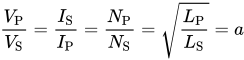
Combining ratio of (1) & (2)
Turns ratio . . . (3) where
for step-down transformers, a > 1
for step-up transformers, a < 1
By law of conservation of energy, apparent, real and reactive power are each conserved in the input and output . . . (4)
Combining (3) & (4) with this endnote[b][4] yields the ideal transformer identity . (5)
By Ohm's law and ideal transformer identity . . . (6)
Apparent load impedance Z'L (ZL referred to the primary) . (7)
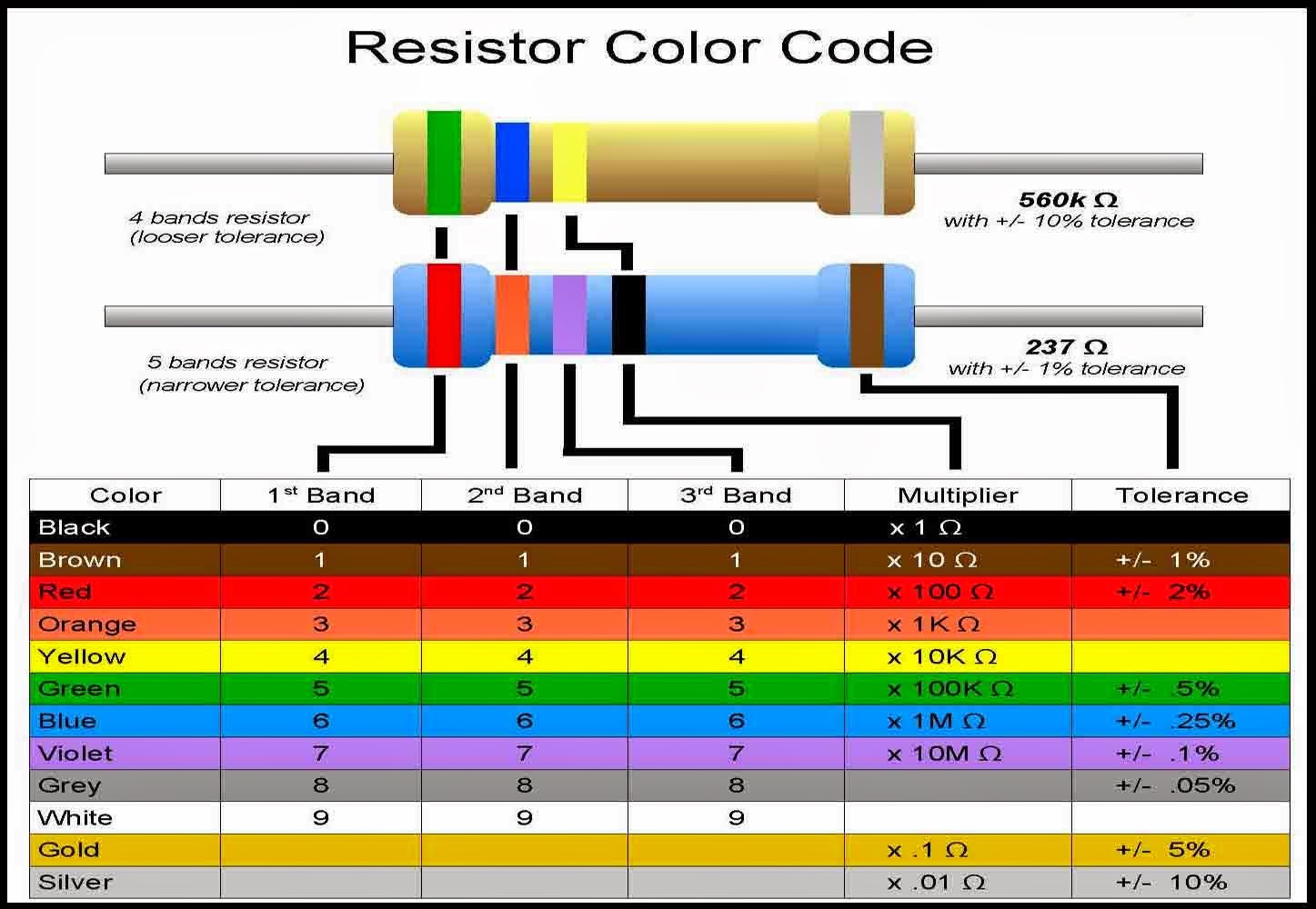
The electronic color code is used to indicate the values or ratings of electronic components, usually for resistors, but also for capacitors, inductors, diodes and others.
Calculating Resistor Values
The Resistor Colour Code system is all well and good
but we need to understand how to apply it in order to get the correct
value of the resistor. The “left-hand” or the most significant coloured
band is the band which is nearest to a connecting lead with the colour
coded bands being read from left-to-right as follows;
Digit, Digit, Multiplier = Colour, Colour x 10 colour in Ohm’s (Ω’s)
For example, a resistor has the following coloured markings;
YellowVioletRed = 472 = 47 x 102 = 4700Ω or 4k7.
The fourth and fifth bands are used to determine the percentage
tolerance of the resistor. Resistor tolerance is a measure of the
resistors variation from the specified resistive value and is a
consequence of the manufacturing process and is expressed as a
percentage of its “nominal” or preferred value.
Related Products: Resistor Fixed Single-Other Mounting
Typical resistor tolerances for film resistors range from 1% to 10%
while carbon resistors have tolerances up to 20%. Resistors with
tolerances lower than 2% are called precision resistors with the or
lower tolerance resistors being more expensive.
Most five band resistors are precision resistors with tolerances of
either 1% or 2% while most of the four band resistors have tolerances of
5%, 10% and 20%. The colour code used to denote the tolerance rating of
a resistor is given as;
Brown = 1%, Red = 2%, Gold = 5%, Silver = 10 %
If resistor has no fourth tolerance band then the default tolerance would be at 20%.
It is sometimes easier to remember the resistor colour code by using
mnemonics or phrases that have a separate word in the phrase to
represent each of the Ten + Two colours in the code. However, these
sayings are often very crude but never the less effective for
remembering the resistor colours. Here are just a few of the more
“cleaner” versions but many more exist:
Bad Booze Rots Our Young Guts But Vodka Goes Well
Bad Boys Ring Our Young Girls But Vicky Goes Without
Bad Boys Ring Our Young Girls But Vicky Gives Willingly — Get Some Now (This one is only slightly better because it includes the tolerance bands of Gold, Silver, and None).
is a branch of physics concerned with heat and temperature and their relation to energy and work. Thermodynamics is the study of heat, "thermo," and work, "dynamics." Thermodynamics is a branch of physics which deals with the energy
and work of a system. It was born in the 19th century as scientists
were first discovering how to build and operate steam engines.
Thermodynamics deals only with the
large scale response
of a system
which we can observe and measure in experiments. Small scale gas
interactions are described by the kinetic
theory of gases.
The methods complement each other; some principles are more easily
understood in terms of thermodynamics and some principles are more
easily explained by kinetic theory.
Thermodynamics
The 4 Laws
Zeroth law of thermodynamics – If two
thermodynamic systems are each in thermal equilibrium with a third, then
they are in thermal equilibrium with each other.
First law of thermodynamics – Energy
can neither be created nor destroyed. It can only change forms. In any
process, the total energy of the universe remains the same. For a
thermodynamic cycle the net heat supplied to the system equals the net
work done by the system.
Second law of thermodynamics – The
entropy of an isolated system not in equilibrium will tend to increase
over time, approaching a maximum value at equilibrium.
Third law of thermodynamics – As temperature approaches absolute zero, the entropy of a system approaches a constant minimum.
Armature reaction in a DC machine. In a DC machine, the main field is produced by field coils. In both the generating and motoring modes, the armature carries current and a magnetic field is established, which is called the armature flux. The effect of armature flux on the main field is called the armature reaction.
Stephen William Hawking was born on 8 January 1942 (300 years after the
death of Galileo) in Oxford, England. His parents' house was in north
London, but during the second world war, Oxford was considered a safer
place to have babies. When he was eight, his family moved to St. Albans,
a town about 20 miles north of London. At the age of eleven, Stephen
went to St. Albans School and then on to University College, Oxford; his
father's old college. Stephen wanted to study Mathematics, although his
father would have preferred medicine. Mathematics was not available at
University College, so he pursued Physics instead. After three years and
not very much work, he was awarded a first class honours degree in
Natural Science.
Stephen Hawking has worked on the basic laws which govern the universe.
With Roger Penrose he showed that Einstein's General Theory of
Relativity implied space and time would have a beginning in the Big Bang
and an end in black holes.
He is a fellow of the
Royal Society and a member of the US National Academy of Science.
Stephen Hawking is regarded as one of the most brilliant theoretical
physicists since Einstein.
Stephen was diagnosed with ALS, a form of Motor Neurone Disease, shortly
after his 21st birthday. In spite of being wheelchair bound and
dependent on a computerised voice system for communication Stephen
Hawking continues to combine family life (he has three children and
three grandchildren), and his research into theoretical physics together
with an extensive programme of travel and public lectures. He still
hopes to make it into space one day.Stephen was diagnosed with ALS, a form of Motor Neurone Disease, shortly
after his 21st birthday. In spite of being wheelchair bound and
dependent on a computerised voice system for communication Stephen
Hawking continues to combine family life (he has three children and
three grandchildren), and his research into theoretical physics together
with an extensive programme of travel and public lectures. He still
hopes to make it into space one day.
A black hole
is a region of spacetime exhibiting such strong gravitational effects
that nothing—not even particles and electromagnetic radiation such as
light—can escape from inside it
A black hole is a region in space where the pulling force of gravity
is so strong that light is not able to escape. The strong gravity occurs
because matter has been pressed into a tiny space. This compression can
take place at the end of a star's life. Some black holes are a result
of dying stars.
Because no light can escape, black holes are invisible. However,
space telescopes with special instruments can help find black holes.
They can observe the behavior of material and stars that are very close
to black holes.
How Big Are Black Holes?
Black holes can come in a range of sizes, but there are three main types of black holes. The black hole's mass and size determine what kind it is.
The smallest ones are known as primordial black holes. Scientists
believe this type of black hole is as small as a single atom but with
the mass of a large mountain.
The most common type of medium-sized black holes is called "stellar."
The mass of a stellar black hole can be up to 20 times greater than the
mass of the sun and can fit inside a ball with a diameter of about 10
miles. Dozens of stellar mass black holes may exist within the Milky Way
galaxy.
The largest black holes are called "supermassive." These black holes
have masses greater than 1 million suns combined and would fit inside a
ball with a diameter about the size of the solar system. Scientific
evidence suggests that every large galaxy contains a supermassive black
hole at its center. The supermassive black hole at the center of the
Milky Way galaxy is called Sagittarius A. It has a mass equal to about 4
million suns and would fit inside a ball with a diameter about the size
of the sun.
How Do Black Holes Form?
Primordial black holes are thought to have formed in the early universe, soon after the big bang.
Stellar black holes form when the center of a very massive star
collapses in upon itself. This collapse also causes a supernova, or an
exploding star, that blasts part of the star into space.
Scientists think supermassive black holes formed at the same time as
the galaxy they are in. The size of the supermassive black hole is
related to the size and mass of the galaxy it is in.
If Black Holes Are "Black," How Do Scientists Know They Are There?
A black hole can not be seen because of the strong gravity that is
pulling all of the light into the black hole's center. However,
scientists can see the effects of its strong gravity on the stars and
gases around it. If a star is orbiting a certain point in space,
scientists can study the star's motion to find out if it is orbiting a
black hole.
When a black hole and a star are orbiting close together, high-energy
light is produced. Scientific instruments can see this high-energy
light.
A black hole's gravity can sometimes be strong enough to pull off the
outer gases of the star and grow a disk around itself called the
accretion disk. As gas from the accretion disk spirals into the black
hole, the gas heats to very high temperatures and releases X-ray light
in all directions. NASA telescopes measure the X-ray light. Astronomers
use this information to learn more about the properties of a black hole.
Could a Black Hole Destroy Earth?
Black holes do not wander around the universe, randomly swallowing
worlds. They follow the laws of gravity just like other objects in
space. The orbit of a black hole would have to be very close to the
solar system to affect Earth, which is not likely.
If a black hole with the same mass as the sun were to replace the
sun, Earth would not fall in. The black hole with the same mass as the
sun would keep the same gravity as the sun. The planets would still
orbit the black hole as they orbit the sun now.
Will the Sun Ever Turn Into a Black Hole?
The sun does not have enough mass to collapse into a black hole. In
billions of years, when the sun is at the end of its life, it will
become a red giant star. Then, when it has used the last of its
fuel, it will throw off its outer layers and turn into a glowing ring of
gas called a planetary nebula. Finally, all that will be left of the
sun is a cooling white dwarf star.
How Is NASA Studying Black Holes?
NASA is learning about black holes using spacecraft like the Chandra
X-ray Observatory, the Swift satellite and the Fermi Gamma-ray Space
Telescope. Fermi launched in 2008 and is observing gamma rays - the most
energetic form of light - in search of supermassive black holes and
other astronomical phenomena. Spacecraft like these help scientists
answer questions about the origin, evolution and destiny of the
universe.


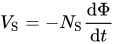 . . . (1)[a]
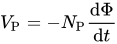 . . . (2)
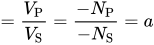 . . . (3) where
 . . . (4)
 . (5)
. (5) . . . (6)
 . (7)
. (7)