Monday, November 20, 2017

UPSC MAINS POLITICAL SCIENCE SYLLABUS


 UPSC MAINS POLITICAL SCIENCE SYLLABUS PAPER – I

Political Theory and Indian Politics:

Political Theory: meaning and approaches.
Theories of the State: Liberal, Neo-liberal, Pluralist, Marxist, Post-colonial, and feminist.
Justice: Conceptions of justice.Rawl’s theory of justice and its communitarian critiques.
Equality: Political, Social and economic; relationship between equality and freedom; Affirmative action.
Rights: Meaning and theories; different kinds of rights; concept of Human Rights.
Democracy: Classical theories and contemporary theories; different models of democracy – participatory, representative,  and deliberative.
Concept of power, ideology, hegemony, and legitimacy.
Political Ideologies: Liberalism, Marxism, Socialism, Fascism, Gandhism and Feminism.
Indian Political Thought: Dharmashastra, Sir Syed Ahmed Khan, Arthashastra and Buddhist traditions; Sri Aurobindo, M.N. Roy, M.K. Gandhi, B.R. Ambedkar.
Western Political Thought: Plato, Aristotle, Machiavelli, Locke, Hobbes, John S. Mill, Marx, Gramsci, and Hannah Arendt.

Indian Government and Politics:

Indian Nationalism:
(a) India’s Freedom Struggle: Political Strategies, Constitutionalism to mass Satyagraha, Civil Disobedience, Liberal and Non-cooperation; Peasant and workers’ movements, Militant and revolutionary movements.
(b) Perspectives on Indian National Movement: Liberal andMarxist; Radical humanist and Dalit.
Making of the Indian Constitution:
Legacies of the British rule; various social and political perspectives.
Salient Features of the Indian Constitution: The Preamble, Directive Principles; Fundamental Rights and Duties, Parliamentary System and Constitutional Amendment Procedures; Judicial Review and Basic Structure doctrine.
(a) Principal Organs of the Union Government:  role and actual working of thelegislature, Executive  and Supreme Court.
(b) Principal Organs of the State Government: role and actual working of the Legislature,  Executive, and High Courts.
Grassroots Democracy: Panchayati Raj and Municipal Government; Grass root movements , significance of 73rd and 74th Amendments;.
Statutory Institutions/Commissions: Election Commission, Finance Commission, Comptroller and Auditor General, , Union Public Service Commission, National Commission for Scheduled Tribes, National Commission for Scheduled Castes,  National Commission for Women; National Commission for Minorities ,National Human Rights Commission,  National Backward Classes Commission.
Federalism: Constitutional provisions related to; changing nature of state- center relations; integrationist tendencies and regional aspirations; inter-state disputes.
Planning and Economic Development : Gandhian and Nehruvian  perspectives; role of planning and public sector; Green Revolution, land reforms and agrarian relations; liberalization and its impact and economic reforms.
Caste, Religion and Ethnicity in Indian Politics.
Party System: National and regional political parties, social base and ideological bases of parties; patterns of coalition politics; trends in electoral behavior; Pressure groups, changing socio- economic profile of Legislators.
Social Movements: Women’s movements; Civil liberties and human rights movements; environmentalist movements.

UPSC MAINS POLITICAL SCIENCE SYLLABUS PAPER – 2


Comparative Politics and International Relations

Comparative Politics: Nature and  approaches;  political economy and political sociology, perspectives and limitations of the comparative method.
Study of State in comparative perspective: Characteristics and changing nature of the State in socialist and capitalist economies  and  advanced industrial and developing societies.
Politics of Participation and Representation :  Pressure groups, Political parties and social movements in advanced industrial and developing societies.
Globalization: Responses from different developing and developed  societies.
Approaches to the Study of International Relations: Idealist, Realist, Functionalist, Marxist  and Systems theory.
Key concepts in International Relations: National interest, Security and power; Transnational actors and collective security, Balance of power and deterrence; World capitalist economy and globalization.
Changing International Political Order:
(a) Rise of super powers; ideological and strategic Bipolarity, arms race and Cold War; nuclear threat;
(b) Non-aligned movement: Concept, Aims and achievements;
(c) Collapse of the Soviet Union; relevance of non-alignment in the contemporary world, Unipolarity and American hegemony.
Evolution of the International Economic System:
From Bretton woods to WTO; Socialist economies and the CMEA (Council for Mutual Economic Assistance); Globalization of the world economy, Third World demand for new international economic order.
United Nations:
Emergence, role and actual record: specialised agencies of  UN and their aims and functioning; a need for UN reforms.
Regionalization of World Politics: APEC, EU, ASEAN,  SAARC, NAFTA.
Contemporary Global Concerns: Democracy, environment, human rights, gender justice, terrorism, nuclear proliferation
India and the World:
Indian Foreign Policy: Determinants of foreign policy; continuity and change,  institutions of policy-making.
India’s Contribution to the Non- Alignment Movement:  Study of Different phases and current role.
India and South Asia:
(a) Regional Co-operation: SAARC – existence,past performance and future prospects.
(b) South Asia and concept of  Free Trade Area.
(c) India and its “Look East” policy.
(d) Impediments to regional co-operation: illegal cross-border migration; river water disputes; ethnic conflicts and insurgencies; border disputes.
India and the Global South: Relations with Latin America and Africa ; leadership role in the demand for WTO and NIEO negotiations.
India and the Global Centers of Power: EU, USA,  Japan, China and Russia.
India and the UN System: Its role in UN Peace-keeping; India’s demand for Permanent Seat in the Security Council.
India and the Nuclear Power Question: Changing perceptions and policy.
Recent developments in Indian Foreign policy: India and its position on the recent crisis in Iraq , Afghanistan, and West Asia, growing relations with Israel and US; vision of a new world order.

Click here to download syllabus  in pdf format for Political Science of UPSC Mains.

Read updates of UPSC Recruitment and other notification of UPSC. It also covers syllabus of other optional papers.

Wednesday, November 15, 2017

EDUCATIONAL ANDROID APP AKP


EDUCATIONAL ANDROID APP AKP

hi guys this is my first educational app which support android system and you can download from here


http://app.appsgeyser.com/5963824/Home%20Search

Sunday, November 12, 2017

HOW TO GET RID OF from RATS चूहों से छुटकारा कैसे ले without kill him 2


HOW TO GET RID OF from RATS चूहों से छुटकारा कैसे ले without kill him 2


How can we free phone call by internet..


How can we free phone call by internet..

HELLO GUYS IN THIS VDO SHOWING HOW WE CAN DO FREE CALLING BY INTERNET. LETS START FREE CALLING AND SAVE MONEY ..........


Wednesday, May 17, 2017

Computer virus

Computer virus


 computer virus is a type of malicious software program ("malware") that, when executed, replicates by reproducing itself (copying its own source code) by infecting other computer programs by modifying them.[1] Infecting computer programs can include as well, data files, or the "boot" sector of the hard drive. When this replication succeeds, the affected areas are then said to be "infected" with a computer virusr virus


 Computer viruses currently cause billions of dollars' worth of economic damage each year

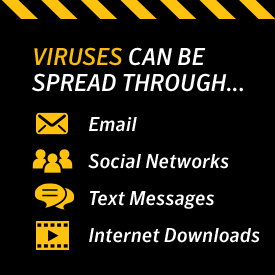
Once a virus has successfully attached to a program, file, or document, the virus will lie dormant until circumstances cause the computer or device to execute its code. In order for a virus to infect your computer, you have to run the infected program, which in turn causes the virus code to be executed. This means that a virus can remain dormant on your computer, without showing major sings or symptoms. However, once the virus infects your computer, the virus can infect other computers on the same network. Stealing passwords or data, logging keystrokes, corrupting files, spamming your email contacts, and even taking over your machine are just some of the devastating and irritating things a virus can do.

 TYPE OF  Computer virus

Most Common Types of Viruses and Other Malicious Programs

1. Resident Viruses

This type of virus is a permanent which dwells in the RAM memory. From there it can overcome and interrupt all of the operations executed by the system: corrupting files and programs that are opened, closed, copied, renamed etc.

Examples include: Randex, CMJ, Meve, and MrKlunky.

2. Multipartite Viruses

Multipartite viruses are distributed through infected media and usually hide in the memory. Gradually, the virus moves to the boot sector of the hard drive and infects executable files on the hard drive and later across the computer system.

3. Direct Action Viruses

The main purpose of this virus is to replicate and take action when it is executed. When a specific condition is met, the virus will go into action and infect files in the directory or folder that it is in and in directories that are specified in the AUTOEXEC.BAT file PATH. This batch file is always located in the root directory of the hard disk and carries out certain operations when the computer is booted.

4. Overwrite Viruses

Virus of this kind is characterized by the fact that it deletes the information contained in the files that it infects, rendering them partially or totally useless once they have been infected.

The only way to clean a file infected by an overwrite virus is to delete the file completely, thus losing the original content.

Examples of this virus include: Way, Trj.Reboot, Trivial.88.D.

5. Boot Virus

This type of virus affects the boot sector of a floppy or hard disk. This is a crucial part of a disk, in which information on the disk itself is stored together with a program that makes it possible to boot (start) the computer from the disk.

The best way of avoiding boot viruses is to ensure that floppy disks are write-protected and never start your computer with an unknown floppy disk in the disk drive.

Examples of boot viruses include: Polyboot.B, AntiEXE.

6. Macro Virus

Macro viruses infect files that are created using certain applications or programs that contain macros. These mini-programs make it possible to automate series of operations so that they are performed as a single action, thereby saving the user from having to carry them out one by one.

Examples of macro viruses: Relax, Melissa.A, Bablas, O97M/Y2K.

7. Directory Virus

Directory viruses change the paths that indicate the location of a file. By executing a program (file with the extension .EXE or .COM) which has been infected by a virus, you are unknowingly running the virus program, while the original file and program have been previously moved by the virus.

Once infected it becomes impossible to locate the original files.

8. Polymorphic Virus

Polymorphic viruses encrypt or encode themselves in a different way (using different algorithms and encryption keys) every time they infect a system.

This makes it impossible for anti-viruses to find them using string or signature searches (because they are different in each encryption) and also enables them to create a large number of copies of themselves.

Examples include: Elkern, Marburg, Satan Bug, and Tuareg.

9. File Infectors

This type of virus infects programs or executable files (files with an .EXE or .COM extension). When one of these programs is run, directly or indirectly, the virus is activated, producing the damaging effects it is programmed to carry out. The majority of existing viruses belongs to this category, and can be classified depending on the actions that they carry out.

10. Encrypted Viruses

This type of viruses consists of encrypted malicious code, decrypted module. The viruses use encrypted code technique which make antivirus software hardly to detect them. The antivirus program usually can detect this type of viruses when they try spread by decrypted themselves.

11. Companion Viruses

Companion viruses can be considered file infector viruses like resident or direct action types. They are known as companion viruses because once they get into the system they "accompany" the other files that already exist. In other words, in order to carry out their infection routines, companion viruses can wait in memory until a program is run (resident viruses) or act immediately by making copies of themselves (direct action viruses).

Some examples include: Stator, Asimov.1539, and Terrax.1069

12. Network Virus

Network viruses rapidly spread through a Local Network Area (LAN), and sometimes throughout the internet. Generally, network viruses multiply through shared resources, i.e., shared drives and folders. When the virus infects a computer, it searches through the network to attack its new potential prey. When the virus finishes infecting that computer, it moves on to the next and the cycle repeats itself.

The most dangerous network viruses are Nimda and SQLSlammer.

13. Nonresident Viruses

This type of viruses is similar to Resident Viruses by using replication of module. Besides that, Nonresident Viruses role as finder module which can infect to files when it found one (it will select one or more files to infect each time the module is executed).

14. Stealth Viruses

Stealth Viruses is some sort of viruses which try to trick anti-virus software by intercepting its requests to the operating system. It has ability to hide itself from some antivirus software programs. Therefore, some antivirus program cannot detect them.

15. Sparse Infectors

In order to spread widely, a virus must attempt to avoid detection. To minimize the probability of its being discovered a virus could use any number of different techniques. It might, for example, only infect every 20th time a file is executed; it might only infect files whose lengths are within narrowly defined ranges or whose names begin with letters in a certain range of the alphabet. There are many other possibilities.

16. Spacefiller (Cavity) Viruses

Many viruses take the easy way out when infecting files; they simply attach themselves to the end of the file and then change the start of the program so that it first points to the virus and then to the actual program code. Many viruses that do this also implement some stealth techniques so you don't see the increase in file length when the virus is active in memory.

A spacefiller (cavity) virus, on the other hand, attempts to be clever. Some program files, for a variety of reasons, have empty space inside of them. This empty space can be used to house virus code. A spacefiller virus attempts to install itself in this empty space while not damaging the actual program itself. An advantage of this is that the virus then does not increase the length of the program and can avoid the need for some stealth techniques. The Lehigh virus was an early example of a spacefiller virus.

17. FAT Virus

The file allocation table or FAT is the part of a disk used to connect information and is a vital part of the normal functioning of the computer. 

This type of virus attack can be especially dangerous, by preventing access to certain sections of the disk where important files are stored. Damage caused can result in information losses from individual files or even entire directories.

18. Worms

A worm is technically not a virus, but a program very similar to a virus; it has the ability to self-replicate, and can lead to negative effects on your system and most importantly they are detected and eliminated by antiviruses.

Examples of worms include: PSWBugbear.B, Lovgate.F, Trile.C, Sobig.D, Mapson.

19. Trojans or Trojan Horses

Another unsavory breed of malicious code (not a virus as well) are Trojans or Trojan horses, which unlike viruses do not reproduce by infecting other files, nor do they self-replicate like worms.

20. Logic Bombs

They are not considered viruses because they do not replicate. They are not even programs in their own right but rather camouflaged segments of other programs.

Their objective is to destroy data on the computer once certain conditions have been met. Logic bombs go undetected until launched, and the results can be destructive.


How to protect against computer viruses?

As you can see, just like a vicious flu virus, a computer virus is something that you want to avoid. The terms virus and malware are often used interchangeably; however, a virus is one of many types of malware, and only one aspect of the overall threat landscape. As a result, traditional antivirus software alone will not fully protect you from all threats.
Instead, look into comprehensive security software like Norton Security.

Tuesday, May 16, 2017

International Court of Justice

International Court of Justice


The International Court of Justice (ICJ) is the principal judicial organ of the United Nations (UN). It was established in June 1945 by the Charter of the United Nations and began work in April 1946.
The seat of the Court is at the Peace Palace in The Hague (Netherlands). Of the six principal organs of the United Nations, it is the only one not located in New York (United States of America).
The Court’s role is to settle, in accordance with international law, legal disputes submitted to it by States and to give advisory opinions on legal questions referred to it by authorized United Nations organs and specialized agencies.
The Court is composed of 15 judges, who are elected for terms of office of nine years by the United Nations General Assembly and the Security Council. It is assisted by a Registry, its administrative organ. Its official languages are English and French.